charles presti
Award Winning Author
I'm not sure whether I'm a painter who writes or a writer who paints. I only know that more people seem to read the acrylics.
Artist Statement
Attention. Memory. Connection.
Through painting and storytelling, I explore the moments that shape us quietly, the stories we carry, and the ways we find one another.
About
From Pensacola, FL.
Charles Presti is a painter and writer whose work explores memory, human connection, and the practice of paying attention.
Working primarily in acrylic on canvas, Charles builds his paintings through planes of color, distilling each scene to what matters most. Rather than recreating a moment exactly as it appeared, he paints what remains—what memory chooses to hold. His work invites viewers to slow down, notice the ordinary, and discover the extraordinary that often hides in plain sight.
In 2026, his paintings received Best of Show honors at Artel Gallery's Fabulous Forgeries exhibition and were later featured in his solo Award Alcove exhibition, SUSPENDED.
Before returning to painting after more than twenty-five years away from the canvas, Charles spent his career in medicine and medical informatics. Caring for patients—and later helping shape the systems that support their care—introduced him to thousands of lives and stories, deepening an awareness that continues to shape both his paintings and his writing.
Charles is also the author of Covered in Flour, recipient of the Next Generation Indie Book Award for First Novel under 50,000 Words, and creator of the Zoe's Garden Tales children's book series, including The Silent Song of Harpo, a finalist in the Children's Book International Competition. Through his weekly essays on Substack, he explores many of the same themes found in his artwork: creativity, memory, kindness, and imagination.
He lives and paints in Pensacola with his husband, Mike Bruce. Together for more than thirty years, they share their home with their Wheaten Terrier, Zoey. Together they co-founded Sunday's Child, a nonprofit supporting organizations that promote diversity and inclusion.
Charles also serves on the advisory board of Equity Project Alliance, where art, conversation, and community come together to help strengthen the place he calls home.
Quiet Geometry
I paint the world as memory keeps it.
I hadn’t painted in more than twenty-five years
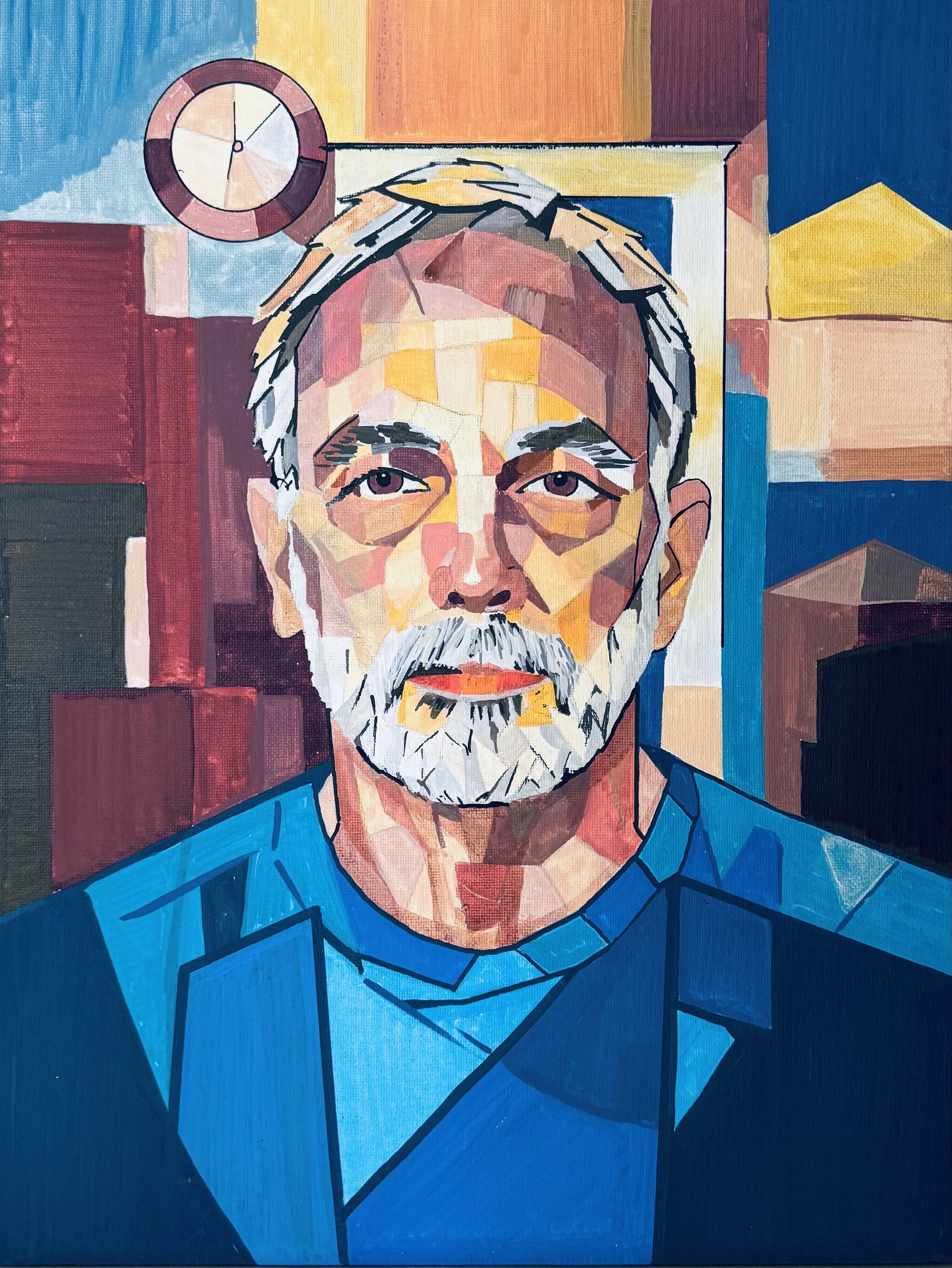
Back when I thought old age was a concept rather than a destination, I promised myself that when I became an old man, I’d start again. No excuses. No delays. I assumed there would be trumpets, maybe a sense of occasion.
Instead, I woke up one morning, looked in the mirror, and realized there had been no announcement at all. No trumpet. No sash. Just the quiet understanding that the man looking back at me was, inconveniently, the one I’d been waiting to become.
So in the fall of 2025, I picked up a brush.
I wish I could say it arrived with some otherworldly calling. It didn’t. I had simply reached the age I once assigned to a mythical future-me. These paintings are what became of that promise—made to a younger man who assumed time would be polite enough to wait.
The work is an attempt to make sense of ordinary moments: wine and Crocs at the counter, Zoey at the cupboard, grandkids hauling Pop-Pop to the candy store, babies suspended in that impossible second before gravity remembers its job.
Nothing here is staged or perfected. It’s simply the world as it looked when it held still long enough to land on canvas.
All of it happened.
Well, most of it.
The Geometry of Memory
From what I can tell, I appear to be in my geometric phase of work. I've come to think of it as Quiet Geometry. I paint in fragments—shapes, angles, and colors—because memory doesn't arrive whole. It comes back in pieces, its shape and meaning altered by time and reinterpretation.
Some sharp. Some softened. All held together by whatever emotion was present when it was formed.
In more recent work, that same attention has widened. Alongside memory and relationship, I've begun looking more directly at the present—at structure, symmetry, and the quieter forces that shape us long before we're aware of it. These pieces are less about recollection and more about observation, but they're rooted in the same impulse: to slow down and notice what is forming us, and how.
What follows is a collection of those fragments—the work itself—each piece an attempt to hold onto something once ordinary and later revealed as anything but.
If any of these scenes feel familiar, that's the point. Most of us don't recognize that what we're living in is extraordinary until it's gone.
When I am Old, I Will Paint
A simple poem